
The demand curve for Cloud Computing services continues to flourish and is a critical element in business. According to IDC, spending on public cloud services and infrastructure across the world will increase by 23.8-percent from 2018, reaching a total spend of $210-billion in 2019. The forecasted five-year compound annual growth rate (CAGR) from 2017 to 2022 is projected to be 22.5-percent to reach $370 billion.
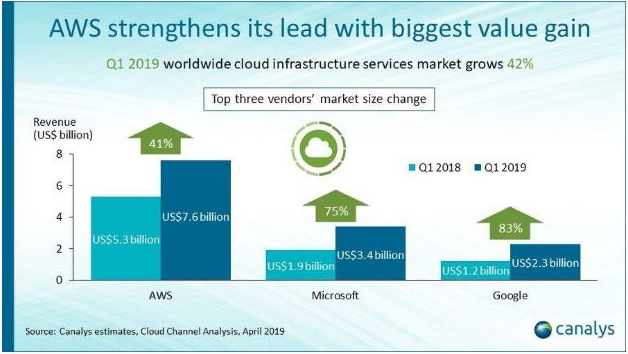
Figure 1: AWS leads in the cloud computing space
In terms of total Cloud Computing service and infrastructure market share, Amazon Web Services (AWS) currently leads and continues to grow. Notable companies committed to using AWS include:
- Lyft spent, $300 million between 2019 and 2021
- Pinterest will spend around, $750 million between 2019 and 2023 and
- Apple spends over, $360 million per year on iCloud and other services
With such names using this dominating platform, let’s first take a closer look at what is AWS and what it has to offer.
What Services Does AWS Offer?
AWS avails its services to businesses through dozens of data centers in Availability Zones (AZs) that are spread in different regions across the world. Each area has multiple AZs, which in turn have several physical data centers. The regions and AZs are all connected by low-latency network links that create a pool of highly reliable infrastructure resources that are resistant to failures of entire data centers or individual servers.
Some of the services in the AWS portfolio by category include:
Storage
Amazon Simple Storage Service (S3), Amazon S3 Glacier, Amazon Elastic Block Store (EBS), Amazon Elastic File System (EFS), AWS Snowball and Snowmobile, and AWS Storage Gateway.
Compute
Amazon Elastic Compute Cloud (EC2), Amazon Elastic Container Service (ECS), Amazon Lightsail, AWS Lambda, and AWS Elastic Beanstalk.
Networking
Amazon Virtual Private Cloud (VPC), AWS Route 53, Cloudfront, API Gateway, and AWS Direct Connect.
Mobile Development
AWS Mobile Hub, AWS Device Farm, AWS Amplify, AWS AppSync, and Amazon Pinpoint.
Messages and Notifications
Amazon Simple Queue Service, Amazon Simple Email Service, and Amazon Simple Notification Service (SNS).
Databases
Amazon DynamoDB, Amazon ElastiCache, Amazon Redshift, and Amazon Relational Database Service (RDS), which includes options for SQL Server, Oracle, PostgreSQL, MySQL, MariaDB, Amazon Aurora.
Migration
AWS Migration Hub contains several tools to help users migrate data, databases, applications, and servers.
Management and Governance
AWS Config, AWS Trusted Advisor, AWS CloudFormation, AWS OpsWorks, Amazon CloudWatch, AWS CloudTrail, and AWS Personal Health Dashboard.
Development Tools and Application Services
AWS Command Line Interface, Amazon API Gateway, Amazon Elastic Transcoder, AWS Step Functions, AWS CodePipeline, AWS CodeStar AWS CodeBuild, AWS CodeDeploy, Amazon Athena for S3, and Amazon QuickSight.
Big Data Management and Analytics
Amazon Elastic MapReduce, Amazon Kinesis, and Amazon Elasticsearch Service
Artificial Intelligence
Amazon AI, AWS Deep Learning AMIs, Amazon Polly, Amazon Rekognition, and Alexa Voice Services.
Security and Governance
AWS Identity and Access Management (IAM), AWS Directory Service, AWS Organizations, and Amazon Inspector.
Other Services
Amazon Chime service, Amazon WorkDocs, Amazon AppStream, AWS IoT service, AWS Greengrass, etc.
Conclusion
Is learning AWS the right path for you? That depends on what career you wish to pursue. Once you decide to go with the cloud, then the best way to get on the right track and boost your employability is by acquiring AWS skills and certifications. There are lots of resources available for both beginners and professionals who want to know how to learn AWS. That said, the most natural path is to enrol for an Amazon Web Services (AWS) Course that offers a combination of theory and practical training.
Why Should you learn AWS? – Wisdom Route
rnmstfpkrw http://www.go7d3s620e3df7r8cm59ze14ch9m37d0s.org/
[url=http://www.go7d3s620e3df7r8cm59ze14ch9m37d0s.org/]urnmstfpkrw[/url]
arnmstfpkrw